
Grading Standards

All MBA Authentication Services
Notes from Mike Baker
Purpose and Value of Professional Grading

“MBA wants to drive transparency in the professional grading industry. Understanding the fundamental truth - that technical grades are a professional opinion, not a statement of fact - is essential to successfully investing and collecting professionally graded items. MBA embraces the healthy reality that professional grading is part science and part tradecraft. While technical grades are highly accountable and repeatable, they are also subjective, with the human professional grader as the ultimate arbiter. MBA applauds our industry for having the finest authentication services of any collectibles market, and I encourage collectors and investors to embrace professional grading for its critical role, while also holding close the healthy reality that the cards themselves are what is precious, and the grades assigned by professional graders are secondary to the cards inherent value and desirability. ”

— Mike Baker

“Like most collectibles, trading cards are designed to be enjoyed and handled. Degradation to an item's surfaces, edges, and corners is normal and does not render an item Altered according to MBA standards. In particular, vintage issues almost universally possess some level of wear, toning, staining, or other damage. Natural degradation is considered a condition flaw. How physical flaws impact the final grade is inherently subjective and always determined by the professional grader at the time of assessment. ”

— Mike Baker

“We grade what we see. Only physical attributes can determine the grade. Aside from natural degradation, only cards that retain physical attributes consistent with the as-manufactured product are eligible for numerical grades. MBA acknowledges that certain flaws, stains, or residue are sometimes lessened or removed to try and improve the card's appearance, technical qualities, or to return the card to the as-manufactured state, and these actions do not necessarily render the card ineligible for a numerical grade. Examples include lying flat a bent corner, lightly erasing a pencil mark, removing fingerprints or dirt, etc. Important to note that cards with any physical attributes inconsistent with the as-manufactured product are generally considered Altered according to MBA standards. ”

— Mike Baker

“Enough is enough. As the original grader in the market I've seen a lot of change over the years. Some good and some bad, but what's happened to vintage authentication is truly frustrating. I've always prioritized the vintage space, but over the recent decade I've seen authenticators largely deprioritize what most advanced investors and collectors agree is the foundation of the market. In the old days authenticators would simply grade what they saw; imagine that. It seems those simpler days are long gone, replaced with new priorities that treat vintage like a bastard stepchild, guilty until proven innocent, and at best tolerated. But while the industry seems to have turned the page, MBA is working to turn it back. My commitment to vintage means MBA will confidently grade what it sees, regardless of the make or issue, regardless of the card's value, free of fear or politics.

Don't believe me that things have changed? I half-seriously suggest a silly (and costly) experiment of resubmitting a few vintage cards (raw, to the same grading company) previously graded NM-MT 8 or higher and document the results. Be sure to share these results with me so we can laugh (and cry) together. Many of the cards graded in the past would grade lower today, and some would be rejected altogether for 'evidence of trimming' or 'evidence of alteration'; evidence which seemingly wasn't present the first time around. I do believe standards have tightened over the years (mine included) but that's not the point. The point is that despite tighter standards, cards are not receiving the grades they rightfully deserve, either because the grades are too high and/or the card's value is too high. Collectors find themselves resubmitting cards multiple times before finally receiving the fair grade; sometimes they never get the fair grade. My point is, the playing field has changed, and if goal posts keep moving so fundamentally as they have, what guarantee do we have that they won't change again? What standards can we rely on to stand the test of time and preserve the trust that's so important to authentication and grading?

The unspoken truth is that skyrocketing values and increasing public scrutiny have combined to make existing authenticators work harder than ever to limit liability. While the reasons for the risk-averse shift may not feel fair, they are straightforward. For existing authenticators, vintage is difficult to train, subsequently more dangerous to grade, and generally thankless compared with the volume, simplicity, and lower risk profiles of TCG and modern sports. The standards of the past, upon which the vintage market was defined, simply aren't worth the present-day business case. Well, I love the vintage market, and I say enough is enough.

MBA has a different view. We honor the market and its history, and that means we appreciate vintage for its inherent importance and will continue to view vintage authentication as a core expertise. The business case to assign grades fairly and deservingly is a business case that makes clear sense to MBA. I and MBA will work diligently to assign grades fairly, based on what we see. We may be strict, but the grade will always be given based on the qualities of the card, period.

Feel similarly? Send us your vintage and lets go. ”

— Mike Baker
10-Step Certification Process

The certification of trading cards involves a meticulous evaluation by MBA experts, who follow a comprehensive 10-point procedure to ensure the highest standards of quality and authenticity.

1
Authenticity
Ensure the asset and/or existing professional grader slab is genuine.
2
Size
Ensure the asset is sized according to manufacturer standards.
3
Alteration
Ensure the asset is void of any unnatural physical attributes.
4
Centering
Ensure the asset is correctly centered.
5
Corners
Review corners for evidence of bends, chips or stock loss.
1
Authenticity
Ensure the asset and/or existing professional grader slab is genuine.
2
Size
Ensure the asset is sized according to manufacturer standards.
3
Alteration
Ensure the asset is void of any unnatural physical attributes.
4
Centering
Ensure the asset is correctly centered.
5
Corners
Review corners for evidence of bends, chips or stock loss.
6
Edges
Review periphery for evidence of bends, chips and dents.
7
Surfaces
Review outer surfaces for scratches, wrinkles, and dirt.
8
Staining & Toning
Assess stock material for abnormal toning and/or staining for foreign substances.
9
Print
Assess the manufacturer's print quality, looking for blemishes, snow, and print dots.
10
Eye Appeal
Consider the asset's overall presentation and luster.
6
Edges
Review periphery for evidence of bends, chips and dents.
7
Surfaces
Review outer surfaces for scratches, wrinkles, and dirt.
8
Staining & Toning
Assess stock material for abnormal toning and/or staining for foreign substances.
9
Print
Assess the manufacturer's print quality, looking for blemishes, snow, and print dots.
10
Eye Appeal
Consider the asset's overall presentation and luster.
  • Verify the asset is factory issued. Only original factory issued assets are valid for authentication. Non-licensed reprints, including counterfeits, are considered inauthentic and will be labeled accordingly.
  • Graded holder inspection to ensure there are no signs of tampering. (MBA Diamond Certification Service only)
  • Note regarding sheet-cut productions: Manufacturer intended sheet-cut issues are generally eligible for numerical grading/slabbing with the ‘Hand-Cut’ designation stated on the label. Please note that sheet cut productions must hold a previously assigned numerical grade to be eligible for MBA Diamond Certification services.
  • Standardized, high-resolution photos are captured of every trading card, from which digital measurements are recorded.
  • Factory-stated measurements are accepted industry standard; known variances in manufacturer sizing and taken into consideration. It is well understood that modern issues are more accurate to manufacturer stated sizing than vintage issues which held looser quality control. standards for different types and brands, and any variations may be taken into consideration.
  • Authentic trading cards which are determined undersized may not be eligible for numerical grade and/or Diamond Certification awards. Final discretion will always be made by MBA experts.
  • Evidence of unnatural, a-typical manufacturer physical attributes - artificially applied or otherwise - may warrant a technical grade of Authentic Altered. Authentic Altered assets retain considerable market value, but are generally lower value than unaltered examples.
  • An Authentic Altered assessment is only an opinion, and items which receive the MBA Authentic Altered assessment must present clear and convincing physical evidence of alteration. Final discretion will always be made by MBA experts.
  • Both the front and back centering of the card are measured by percentage ratio, considering top-to-bottom and left-to-right comparisons.
  • Centering can require expert interpretation in some instances. Final determination will always be made by MBA experts.

  • Corners are inspected for evidence of natural degradation, including fraying, creasing, wrinkles, bends, chips, and other types of wear.

  • Edges are inspected for fraying, chipping, uneven factory cuts, and other edge-related flaws.
  • Surfaces front and back are checked for scratches, missing stock, wrinkles, creases, and other surface flaws.
  • Surfaces are further inspected for physical evidence of stains such gum, water, tobacco, wax, or other substance.
  • The item is also inspected for toning and brightness compared to the original as-manufactured standards.
  • The item’s production quality is inspected for factory print defects that affect overall appearance, such as white "snow" and/or print dots/fisheyes, focus shifts, and other flaws. Imperfections are evaluated for severity based on location and overall impact to presentation.
  • Evaluation of print quality can require expert interpretation in some instances. Final determination will always be made by MBA experts.
  • The card's overall visual appeal is assessed. In some instances, an asset with superior eye appeal will receive a higher numerical grade. Final determination will always be made by MBA experts.
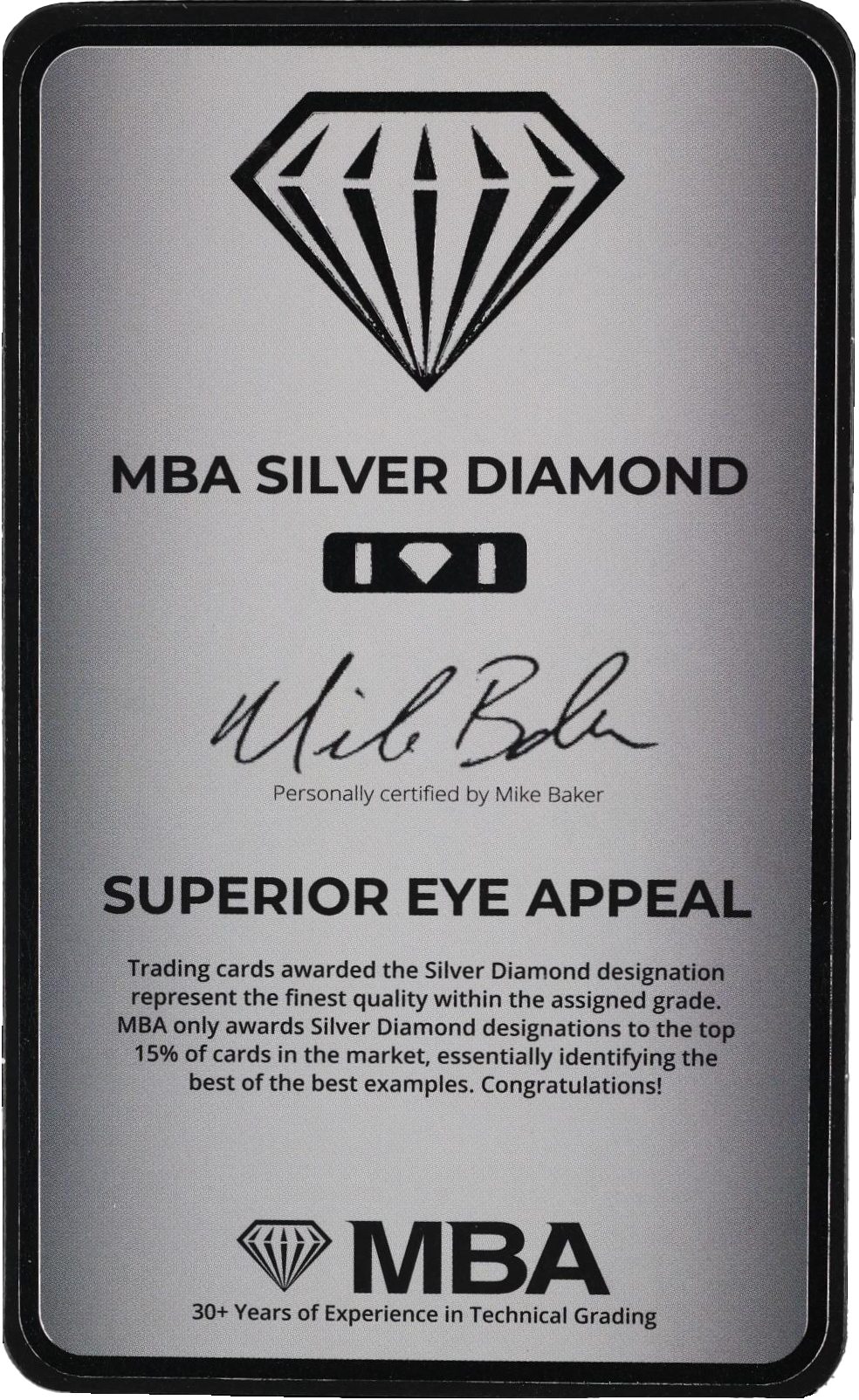
  • The MBA Silver Diamond Certification is awarded to cards which hold superior eye appeal within the otherwise accurate technical grade. Trading cards with super eye appeal generally receive higher market valuations.
Grading Scale

Click to expand and review the certification standards for each MBA assessment. These standards apply to both graded and raw card services.

Silver Diamond, Superior Eye Appeal (SD)
MBA Silver Diamond designations are awarded to graded trading cards that possess Superior Eye Appeal within the assigned technical grade. This can be awarded to any card graded by MBA, PSA, SGC, Beckett, or CGC. Trading cards vary in presentation considerably, even within the same technical grade, and those which possess the Superior Eye Appeal are often valued higher in the market.
A virtually flawless card that exhibits no imperfections under 7x magnification. It boasts superior features such as four impeccably sharp corners, outstanding print quality, and a precisely centered image with a 50/50 alignment on the front and back. MBA’s Team recognizes the Flawless designation with our Black Diamond Certification.
This near-flawless card showcases four impeccably sharp corners and superior print quality. Extremely minor printing imperfections are tolerable under 7x magnification. The image must maintain central positioning on the card, with a front tolerance not exceeding approximately 50/50 percent and a reverse tolerance of 55/45 percent.
Displaying nearly flawless qualities, this card boasts four perfectly sharp corners and superior print quality. A minor imperfection may be permissible, but the image must maintain central positioning, with a front tolerance not exceeding approximately 55/45 percent and a reverse tolerance of 65/35 percent.
In excellent condition, this card features four sharp corners with only a single minor flaw. Despite initial visual resemblance to a Gem Mint Card, close inspection may reveal a minor flaw. Centering requirements include 55/45 or better on the front and 65/35 or better on the reverse.
Superbly conditioned, this card showcases four sharp corners and only one minor flaw, which may become apparent upon close examination. Imperfections, such as a slight nick, small gloss break, surface scratch, minor print or refractor line, focus or color imperfection, or a small print spot, are considered. Centering must be approximately 60/40 or better on the front and 85/15 or better on the reverse.
Initially presenting itself as Mint 9 to the naked eye, this high-quality card showcases technical features akin to an (NM/MT) card, featuring exceptional print quality that allows for minor imperfections. Front centering should be 60/40 or better, and reverse centering should be 85/15 or better. Despite an initial under-grading upon first glance, the overall visual appeal surpasses examples from known print runs.
Featuring noticeable sharp corners at first glance, this card may reveal subtle signs of wear upon closer inspection. Minor flaws, such as slight wear on a corner, a gloss break, surface scratch, print line, refractor line, focus or color imperfection, or a print spot, may be uncovered. Front centering should be approximately 65/35 or better, and reverse centering should be 90/10 or better.
The card will demonstrate technical attributes similar to a (NM) card, boasting exceptional print quality that permits minor imperfections. Front centering should be 65/35 or better, and reverse centering should be 90/10 or better. Despite an initial under-grading at first glance, the overall visual appeal exceeds examples from known print runs.
Graded at 7, this card might display slight wear on three or more corners and/or have slightly rough edges. A minor imperfection, such as a slightly out-of-register image or a permissible minor diamond cut, is acceptable. Minimal wax staining is allowed on the reverse side. Front centering should be approximately 70/30 or better, and reverse centering should be 90/10 or better.
The card will demonstrate technical attributes similar to an (EX/MT) card, boasting exceptional print quality that permits minor imperfections. Front centering should be 70/30 or better, and reverse centering should be 90/10 or better. Despite an initial under-grading at first glance, the overall visual appeal exceeds examples from known print runs.
The card should display front centering of 75/25 or better and reverse centering of 90/10 or better. There is a potential for slight fuzzing of corners, more noticeable skewed cuts, and the chance of focus or register issues. Additionally, there may be slight notching along the edges. While the card might exhibit visible surface wear or a printing defect, these issues should not significantly diminish its overall appeal. A very light scratch, only discernible upon close inspection, may be present, and corners might exhibit a subtle, graduated fraying. The picture focus could be slightly out-of-register, and the card may show some loss of its original gloss. There is a possibility of a minor wax stain on the reverse side, and very slight notching on edges might be visible. Off-whiteness on borders is also a potential occurrence.
The card will demonstrate technical attributes similar to an (EX) card, boasting exceptional print quality that permits minor imperfections. Front centering should be 75/25 or better, and reverse centering should be 90/10 or better. Despite an initial under-grading at first glance, the overall visual appeal exceeds examples from known print runs.
The card should exhibit front centering of 80/20 or better and reverse centering of 90/10 or better. It will display minor rounding or fuzzing of corners and slight roughness or chipping along the edges (with no layering). On one side of the card, there may be one very slight surface or "spider" crease. The surface gloss may be lost, accompanied by some scratching that does not significantly detract from the card's aesthetics. Additionally, there is a subtle emergence of very minor rounding of the corners, making surface wear or printing defects more visible. Minor chipping on the edges might be present, and the loss of the original gloss becomes more apparent. The picture focus might be slightly out-of-register, and several light scratches could be visible upon close inspection, though they do not diminish the overall appeal of the card. Some off-whiteness on the borders may be evident
The card will demonstrate technical attributes similar to a (VG-EX+) card, boasting exceptional print quality that permits minor imperfections. Front centering should be 80/20 or better, and reverse centering should be 90/10 or better. Despite an initial under-grading at first glance, the overall visual appeal exceeds examples from known print runs.
The card should exhibit front centering of 85/15 or better and reverse centering of 90/10 or better. The card's corners may exhibit slight rounding with modest surface wear, including light scuffing or scratches. Some original gloss will still be present, and borders may appear slightly off-white. A faint crease might be observable. Additionally, there may be minor physical evidence of stains or residue present.
The card will demonstrate technical attributes similar to a (VG) card, boasting exceptional print quality that permits minor imperfections. Front centering should be 85/15 or better, and reverse centering should be 95/5 or better. Despite an initial under-grading at first glance, the overall visual appeal exceeds examples from known print runs.
The card should exhibit front centering of 85/15 or better and reverse centering of 90/10 or better. Corners exhibit a slight increase in rounding without reaching an extreme level. There is noticeable surface wear, including potential light scuffing or scratches. The focus may be somewhat off-register, and edges show observable wear. While retaining some original gloss, a significant portion is lost. Borders may show signs of yellowing and/or discoloration, and a visible crease is present. Possible printing defects are acknowledged, and a slight stain may be visible on the obverse, with more pronounced wax staining on the reverse. Overall, there is a diminished focus, registration, and heightened visibility of discoloration and staining.
The card will demonstrate technical attributes similar to a (G) card, boasting exceptional print quality that permits minor imperfections. Front centering should be 85/15 or better, and reverse centering should be 99/1 or better. Despite an initial under-grading at first glance, the overall visual appeal exceeds examples from known print runs.
The card should exhibit front centering of 90/10 or better and reverse centering of 99/1 or better. This card usually shows pronounced rounding of corners and evident surface wear, with potential signs of scratching, scuffing, light staining, or chipping of enamel on the obverse. Multiple creases may be visible, and the original gloss is frequently entirely absent. Considerable discoloration is observable. Furthermore, the card may display one or more of the following features: heavy print spots, prominent creases, surface scuffing or tears, rounded and/or fraying corners, ink or pencil markings, and/or heavy evidence of staining and residues.
The card will demonstrate technical attributes similar to a (G) card, boasting exceptional print quality that permits minor imperfections. Front centering should be 95/5 or better. Back centering may be poor or miscut. Despite an initial under-grading at first glance, the overall visual appeal exceeds examples from known print runs. Pin holes and paper loss generally denote a grade no higher than Fair.
Typically, a card with a Fair grade will display extreme wear, potentially impacting the framing of the picture. The surface of the card will show advanced stages of wear, including scuffing, scratching, pitting, chipping, staining, and the presence of one or more heavy creases. The picture may be noticeably out-of-register, and the borders could have become brown and dirty. Pinholes may also be present. To attain a Fair grade, the card must remain fully intact, even if heavily worn. However, it cannot achieve this grade if it is missing solid pieces due to a major tear, removal of the back layer, or an entire corner. Additionally, the card may manifest characteristics such as heavy print spots, color or focus imperfections, surface scuffing or tears, rounded and/or fraying corners, ink or pencil markings, a lack of some or all original gloss, and small portions of the card may be missing.

Authentic assessments are provided to items which cannot receive a numerical grade. Important to note that Authentic items are genuine and real, and retain considerable market value despite lacking a numerical grade. Some examples are as follows:

Alteration: Authentic Altered (AA) assessments are assigned to items which depict physical attributes outside of what is considered manufacturer normal attributes and/or normal wear and degradation. Read more about alteration in the MBA Certification Standards section of this page.

Size Limits: Authentic Minimum Size (AMS) assessments are assigned to items which were manufactured outside the minimum size allowable according to MBA size standards.

Other: Authentic (A) assessments are assigned when a numerical grade is not warranted or appropriate. Some type-issue productions and other non-traditional assets for which an industry standard is lacking will sometimes receive an Authentic evaluation.

Some collectibles are not supported by existing MBA services. These items will be returned to submitters with the No-Holder (NH) designation. Note that items with a "No Holder" assessment do not carry any judgement on authenticity or condition.
MBA Service Guarantee

The MBA team has the longest history of professional authentication experience in the market, stemming from our head authenticator, Mike Baker, who first served as head grader at PSA in 1991.

Guarantee

MBA stands behind its product. The certifications provided by MBA carry a lifetime guarantee for the accuracy of the services rendered. All owners of MBA Graded, Diamond Certified, and/or Certified items are guaranteed accuracy of the items they own, in alignment MBA standards.

Any error in accuracy of MBA authentication is limited to the "market value increase" resulting from MBA Authentication. Market value increase is solely determined by MBA staff. The market value increase considered for the Guarantee is limited to the assessed value at the time MBA services were rendered, and this value is statistically determined and verified solely by MBA staff. MBA will always address authentication concerns with an emphasis on protecting collectors and maintaining the highest quality control.

Note that MBA Authenticated items post-authentication, as determined by MBA staff, are not directly covered by the MBA Service Guarantee.

Disclaimer on differing 3rd party grader opinions

Professional grading is an opinion rendered by trained experts who frequently disagree on technical assessments. Differing opinions are a healthy reality in the collectibles markets, and an opinion which varies from a previously certified MBA item does not undermine the accuracy or legitimacy of the MBA certification. Differing opinions are not considered justification for a claim against an MBA product. When applying the MBA Service Guarantee, only the standards at MBA and the accuracy of those standards as applied during the time of authentication, are considered.